
This case study considers an important escalation in the activities of the crowd on the second day of the riots in Bristol on Sunday, 30 October 1831. It begins by framing the events in Bristol in the context of the ‘great excarceration’ of Newgate prison during the Gordon riots of 1780 in London. In the second section the design and operation of the New Gaol in Bristol is examined along with the daily routines of prisoners and the perceptions of outsiders. The third and fourth sections consider in detail the prelude, the attack on the Bridewell gaol, and the assault on the New Gaol respectively. The last sections consider who the liberated prisoners were and, in conclusion, whether hostility to anti-Reformers in Parliament had become inextricably entangled with hostility towards criminal justice and its institutions.
‘Here I saw a new species of gaol delivery. The captives marched out with all the humours of war, accompanied by a musical band of rattling fetters’. [1]
‘Well, we turn’d judges, and so we found all the pris’ners not guilty; and I’m d___d if we aren’t made a reg’lar gaol deliv’ry’. [2]
Contents:
- Introduction
- The New Gaol
- The Great Excarceration: Bridewell
- The Great Excarceration: The New Gaol
- The Escapees
- Conclusion
1. Introduction
The besieging, liberating and burning of Bristol’s fortress-like New Gaol in 1831 was an event without precedent in the history of the city’s many past civil disturbances. It marked not only a serious escalation in the scale and scope of the reform riots, but placed them within a framework that recalled the most destructive national disturbance of the entire previous century, London’s anti-Catholic Gordon riots in 1780, where prisons had also been attacked, liberated and set in fire. This essay has two objectives arising from such a comparison. It seeks firstly to understand the attack on the New Gaol as a pivotal moment in the 1831 riots. It was, we argue, the point at which a protest against the arrival in Bristol of the anti-reforming Recorder, and its development into riot as a consequence of heavy handed civil and military intervention, turned into something less governed by traditional boundaries in crowd behaviour. As it did so, popular collective understandings of ‘reform’ as a demand began to shift and take on broader meanings. The destruction of London’s Newgate gaol during the riots of 1780, writes Ian Haywood, ‘seemed to signify that the riots had grown into a potentially revolutionary struggle to overthrow Britain’s ancient regime’, a fear amplified a few years later by the fall of the Paris Bastille and the revolutionary upheavals that followed it.[3] The burning of Newgate was followed by attacks on several other London prisons and lock-ups, and although the primary objective of the crowd seems to have been the release of rioters taken up by the authorities, this too had been a turning point. As Nicholas Rogers has argued, ‘the riots clearly diverged from their original objectives and began to focus upon social grievances unrelated to Catholic relief. The attacks on the gaols were not simply rescue operations; they connoted a long-standing contempt for the iniquities of the prison system’.[4]
Our second objective is to explore some of the questions raised by Peter Linebaugh’s account of the ‘excarceration’ of Newgate in 1780. Linebaugh collectively profiled the escapees and the attackers in a bid to understand what such an event can tell us about the diversity and common experience of London’s labouring poor, or about popular attitudes to cultures of criminality and the institutions of law. Taken as a group, he concluded, these were men and women of diverse origins but broadly ‘of the propertyless class… in detention for acts against those with property’, and acting under the influence of political debates inspired by the ongoing war with revolutionary America. Linebaugh’s initial questions were these: Who attacked the prison, and why; who was released, and what were the consequences?[5]
As in London half a century earlier, the attack on Bristol’s principal criminal gaol that Sunday afternoon in October 1831 was not an isolated act. Just as the capital’s smaller prisons, including crimping and sponging houses[6] had been liberated in 1780, so in Bristol, the Bridewell, and the Gloucestershire house of correction at Lawford’s Gate were ransacked and fired as well as the New Gaol. A small Sherriff’s officer’s sponging house in Tailor’s Court was also liberated but no attempt was made to fire it. And equally too, it was the assault on each city’s largest and most important prison that drew the largest crowd, produced the greatest consternation, and delivered the heaviest consequences. As the Attorney General put it in opening the prosecution case against the Mayor and magistrates for negligence in October 1832, ‘You will agree, no doubt, with me, that when the mob was parading the town, and getting the upper hand, one of the first objects should have been to secure the gaols from attack’. Yet they were overwhelmed with ease.[7]
Why did crowds of working people agitating for parliamentary reform break into the New Gaol, set fire to some sections of it, and release all the prisoners, both felons and debtors? What did breaking into the gaol have to do with ‘reform’? Or as one horrified ‘friend of the labouring classes’ expressed it, ‘What must the men be, and what their object, who, to procure agents and associates, empty the common gaols ?!’[8]
Sunday’s offensive against the gaols also marked an escalation in two distinct ways. Firstly it marked a shift from targets associated with the parliamentary impasse over the Reform Bill to targets representing parallel grievances and antagonisms, and secondly a shift in behaviours from window-breaking and very selective expropriation to incendiarism. The previous day’s damage to the mayor’s Mansion House was certainly extensive; windows, doors and shutters had been destroyed, furniture smashed and food and wine carried away, but until lunchtime on Sunday, no more serious looting had occurred and no private houses or businesses attacked. If the point seems laboured it is because the language of ‘riot’, as commonly used to evoke wild, unmeasured and recklessly violent collective behaviour, is all too often too blunt a term to capture the complexities of what was going on. As one contemporary commentary would have it, events at Bristol had been characterised by ‘a spirit of wanton riot, of general plunder, and indiscriminate devastation’, fuelled by ‘ignorance, disunion and want’. Simplistic commentary of this kind will not take us very far.[9]
Recent historians of the riots have not been uninterested in the question of escalation over the three days of disturbances, but the systematic liberation and attempted destruction of the gaols has not previously been the subject of close study in its own right. Given that these were actions with no obvious connection to anti-reformers, questions of wider revolutionary intention have been raised, but largely rejected. In John Stevenson’s view, ‘far from being a symptom of impending revolution, the Bristol riot was a reprise of an old theme, the extremely thin line which lay between “order” and “disorder” in the era before the introduction of professional policing’. Absent policing was undoubtedly an issue, but it doesn’t adequately tackle the question of escalation from anti-reform targets to anti-prison targets. Such a solidly built structure as the New Gaol was unlikely to have been attacked on a whim.[10]
Mark Harrison saw a deep-seated and broadly-felt opposition to the antiquated Corporation as a root cause; and that suppression only proved possible (and drew public support) once attacks on public buildings had escalated into attacks on private houses. For him, it is the burning of Queen Square rather than the liberation of the gaols that matters the most. But this is a difficult argument to sustain in riots where the Bishop’s Palace and two sides of Queen Square were destroyed while neither the Guildhall nor the Council House were significantly damaged. Harrison actually had little to say about the attacks on the gaols. For Jeremy Caple on the other hand, ‘none of the actions of the rioters demonstrates their hostility toward authority more than the attacks on local prisons’. Caple understood the relevance of changes in the way law and order was perceived and enforced in the post-war period, and particularly of utilitarian prison reform as an agent of repressive social control. Yet he drew no distinction between the Bridewell and the New Gaol as oppressive institutions. These two prisons were worlds apart in both form and function. In fact, the Bridewell was destroyed despite its continued use as a traditional holding tank for prisoners awaiting trial, and not because it had been modernised along the lines of the New Gaol.[11] We need, above all, to understand the New Gaol both as an institution and as a material intrusion on the Bristol cityscape.
2. The New Gaol

Like London’s Newgate in 1780, Bristol’s New Gaol, built on vacant land near Bathurst Basin, was a relatively new building when it was attacked. It opened for business in 1820, designed to accommodate up to 198 prisoners at a cost of around £100,000, mostly of ratepayers’ money. It was a long overdue replacement for the city’s Newgate gaol on Narrow Wine Street, a cramped, crumbling and insecure structure dating from 1689 and ‘a miserable place’, in the estimation of the Society for the Improvement of Prison Discipline (SIPD) in 1820.[12]
At Newgate, prisoners lived, socialised and slept in communal areas much as they had done for the last 140 years, and apart from the use of a punishment dungeon known as ‘the pit’, reformatory discipline was minimal. The New Gaol, by contrast, was a modern detached radial prison with four wings fanning out from the governor’s house and the chapel. The architect was Henry Hake Seward, designer of the New Hotwell House at Clifton, and its semi-panopticon format allowed prisoners, locked at night into individual sleeping cells ‘to prevent the evils of association’ as one SIPD treatise put it, and to be kept under ‘constant and unobserved inspection’ as soon as they emerged in the morning.[13] Seward was sufficiently proud of his design to exhibit Views of the Principal Front and Entrance Gateway at the summer exhibition of the Royal Academy in 1819.[14]
By 1824, a high perimeter wall had been added, behind which the prison appeared, and was intended to be, impregnable. ‘It has a formidable and terrifying aspect’, thought Pierce Egan. ‘The iron gratings of the windows are strong and massy’, making it ‘a fitting receptacle for the depraved and abandoned’.[15]
It was a complex to be proud of, noted one city guidebook, ‘for health, convenience and excellent arrangement’, an edifice ‘not to be equalled in England, commanding extensive views of the surrounding country’.[16]
Quite how much of the surrounding country most prisoners could expect to see beyond the 20 foot perimeter wall is questionable, but other guides concurred on the excellence of the arrangements at least. ‘It is built in a very strong manner’, it was noted in 1826, and the free association enjoyed at Newgate was clearly over for, ‘the prisoners are arranged in ten different classes, each class being cut off from communication with the rest’. [17]
The first two wings, on either side of the governor’s house, were reserved mainly for debtors, divided by class and gender, although the wing to the right also housed female felons, women awaiting trial and any women awaiting execution. The two back wings were for male felons and men awaiting trial.[18]
Cast iron bridges between each wing and the governor’s house and chapel ensured prisoners never had to leave their allocated ward, even to attend divine service. Steel bridges between each wing and the governor’s house and chapel ensured prisoners never had to leave their allocated ward, even to attend divine service.

Prisoners in each ward used an associated day room and airing yard, with the exception of those prisoners either convicted or awaiting trial for a misdemeanour. These two classes were obliged to share facilities, an oversight much regretted by the magistrates who feared moral contagion. Regardless of class however, all except debtors were ‘compelled to wear a party-coloured dress which, if they could possibly escape, would immediately cause them to be retaken’.[19]
This clothing consisted of a jacket, trousers, shirt, shoes and a cap, and prisoners were each allotted a straw mattress, two blankets and a sheet.[20]
None but the debtors and those awaiting trial were permitted to be idle. The earliest intake of prisoners were even put to work on the building of the lofty perimeter wall, sealing themselves from life outside as they did so. Once that was finished, the male prisoners were set to work from 9am to 6pm every day either quarrying and breaking stones for gravel, or on the treadmill.[21] In some prisons women were also put to labour on the treadmill but at Bristol they were mainly tasked with mending clothing, shoes and blankets.
The prison had its own chaplain and a chapel into which prisoners were herded for prayers three times a week, a considerably more literal interpretation of the requirements of the Prison Act than most prisons managed.[22] Most rooms, including the cells, were heated by means of pneumatic stoves and it was hoped that the site’s more spacious and open setting would permit a healthier circulation of fresh air than had been the case at Newgate. But if the prison diet was also an improvement, it remained fairly limited at a pound and a half of bread a day and a quart of soup five days a week.[23]
As might be expected, indiscipline amongst the felons was met with a range of additional punishments. Solitary confinement might be ordered for ‘indecent behaviour, bad conduct at chapel, refusing to work, etc etc.’ while more serious offences such as robbing a fellow prisoner, stealing vegetables from the garden or taking lead from the tread mill was more likely to be met with a whipping.[24] The prison did not adopt the silent system before the regulations were overhauled in 1840, ‘although care is taken to prevent unnecessary noise’.[25] There is no evidence that prison discipline was difficult to maintain at Bristol, although visiting Justices did express irritation with the unsettling and unasked for presence of deserters, particularly those brought over from Ireland. Magistrates were obliged by government to accept them pending collection by the military authorities, but these were prisoners ‘who frequently conduct themselves in a riotous and disorderly manner and many of whom, at the time of their admission, are infected with the itch and with venereal diseases’. Debtors too had a reputation for challenging prison discipline, ‘contending that they are not subject to the regulations of the visiting magistrates’.[26] This was true. Debtors were divided into two classes, intended primarily to distinguish wealthier from poorer prisoners, and were permitted private family visits to their rooms three days a week. They clearly regarded themselves as a class apart from the common felons.[27]
So far we have considered the New Gaol and its regime from a descriptive point of view, but this will take us only so far. If we are going to fully understand the great excarceration of 1831, we need to ask the more qualitative question, what did the Gaol mean to the labouring class men and women who lived within its shadow? How, to put it bluntly, did it make them feel? In 1826, the Bristol printer, Joseph Matthews, published a new guide to the city, two pages of which were given over to a minutely detailed description of the Gaol in which even its measurements were deemed worthy of notice. It was, without a doubt, the largest public building in the city, unmissable to anyone looking to the South across the Floating Harbour, heading North into the city from the working class districts of Bedminster, or making their way up the Avon in the New Cut.
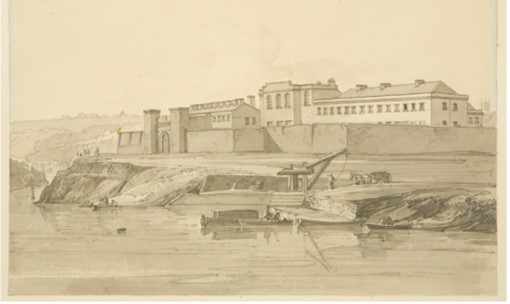
William Clarke, one of those subsequently hanged for his part in the riots and a central figure in the firing of all three of the Bristol gaols, was himself a resident of Bedminster. The Gaol’s blankly imposing perimeter walls, 20 feet in height, topped by a nine inch long cheveaux de fries, and 358 feet across from East to West, enclosed a total area of four acres. Behind them some 200 convicted Bristolians lived and worked, screened from sight. What any of these bald statistics meant to anyone walking past probably depended on who they were, but for Matthews it was a sight to be savoured, for ‘the boundary wall (20 feet high) is built of hewn variegated marble from St Vincents’ Rocks , which has a beautiful appearance’.[28]

The reality of daily life for the men and women on the other side of the wall may have hindered their appreciation of its beauty. Relentless labour on the treadmill, for example, was dreaded and certainly not perceived as useful and healthy exercise. In 1831, the treadmill was still something of an innovation in English prisons and it remained controversial. It began as a response to the spike in criminal prosecutions in the years following demobilisation at the end of the Napoleonic wars. Its simple mechanics solved the problem of finding task work for the increasing number of prisoners consigned to hard labour, teaching in abstract the value of unproductive toil. During the 1820s, as their use quickly spread, some treadmills were adapted for grinding corn for bread, or to pump drinking and washing water around the prison. Bristol gaol had only a small treadmill when it first opened, for pumping water, and operable by just two prisoners at a time. In 1824 however, the city magistrates ordered a second, much larger machine, capable of holding up to twenty prisoners at a time. Lawford’s Gate house of correction followed suit in 1827.[29]
Wherever treadmills were in operation, it was left to local magistrates to determine the strength of resistance in the mechanism and thus calibrate the collective effort required to turn the wheel. Hours spent constantly climbing the steps exacted a heavy toll on prisoners’ mental and physical health and as a form of hard labour the treadmill was greatly resented. Despite the noisy approval of bodies like the SIPD however, the treadmill was not universally welcomed by the public.[30] To begin with, noted its detractors, it had been introduced into the prison system at the whim of magistrates and without parliamentary approval, and in confusing the principles of work with severe physical punishment the treadmill went far beyond customary interpretations of ‘hard labour’. ‘It is on all hands allowed, and in many instances boasted that the punishment of the treadwheel is an object of terror’ argued a pamphleteer in 1824, ‘that it instils a terror sui generis; that in fact it has added a hitherto unknown, a novel terror to the penal code’. As such, it was suggested in polemics like this, the treadmill was probably both unconstitutional and illegal, a debate returned to with some frequency in the newspaper and periodical press.[31]
2. The great excarceration: Bridewell
The crowd attack on the New Gaol began, however, with an attack on the Bridewell, a very different kind of gaol. Bridewell, Bristol’s House of Correction, lay on the southern side of the River Frome, bisected by a narrow lane that divided the keeper’s house from the prison. Wooden gates were drawn across the lane each evening to close the prison to passing pedestrians, but the building remained distinctly vulnerable. It was a prison of the old kind, and, as visiting justices put it in 1824, as such, ‘wholly inadequate’. Bridewell could accommodate no more than 56 prisoners at a time and then only provided 40 of them slept in communal cells. No work or hard labour were provided, just four hours of exercise in a small yard, and there was room for only three class divisions, making promiscuous mixing between all types of prisoner inevitable. Since the cost of upgrading the building was likely to be prohibitive, it was decided during the 1820s to restrict Bridewell to use as a holding tank for prisoners awaiting trial,
a place of confinement for persons pending an examination on charge of felony and for vagrants and deserters, in which cases the separation of the sexes appears to be all that is required, and that prisoners convicted of offences at the assizes and sessions, subjecting them to imprisonment and hard labour, should be sent to undergo their punishments at the common gaol.[32]
For this reason, two men taken up on the night of Saturday 29th October were lodged there while magistrates decided what to do with them. The first signal that a rescue attempt would be made came in Queen Square on Sunday, after the magistrates asked Herapath, from the Political Union, to parley with the mob. ‘The mob listened and cheered him and asked if the bloody bludgeon men had not begun it, and said that they would have the prisoners out of Bridewell, and blood for blood, as they had been fired on.’[33] This was perfectly true; one particularly active stone-thrower had been picked out the previous evening by soldiers from the 14th Light Dragoons sent to defend the Council House, and shot dead at the top of the Pithay. Anger at this shooting prompted Colonel Brereton to order the regiment’s removal to their quarters on College Green on Sunday morning, but they were harassed in their retreat and opened fire once on their pursuers, killing one man and wounding two or three others, according to the military record. Popular accounts were more explicit. According to one contemporary tract, the dragoons had been ‘firing their carbines at intervals’ at stone throwers, so that ‘seven or eight rioters and a spectator on the other side of the quay were wounded’. At midday, Brereton ordered the 14th out of town altogether, to Brislington if accommodation could be found there, or else to Keynsham.[34]
At lunchtime, a small crowd equipped with iron bars and sledge hammers taken from a Nelson Street smithy[35] marched on the Bridewell. The governor, the taskmaster and the turnkey did their best to secure the gates but the crowd pushed them open. After removing both of the gates, breaking them up and throwing them into the river, they were challenged by Thomas Evans, the governor, from an upstairs window of his house. He at first threatened them with a blunderbuss, but backed down once it became clear he could expect no military assistance. The crowd demanded the keys, he surrendered them, all the prisoners were released and the building was fired, beginning with the chapel and ending with Evans’s house. Items of furniture and clothing were thrown from his upstairs rooms while wooden bedframes and planks were piled up in the middle of the prison’s day room to ensure a good blaze. Matthew Worry, for example, was seen going ‘backwards and forwards, dragging out furniture and flinging it into the fire, first smashing it… [witness] heard Worry huzza sometimes’. [36]
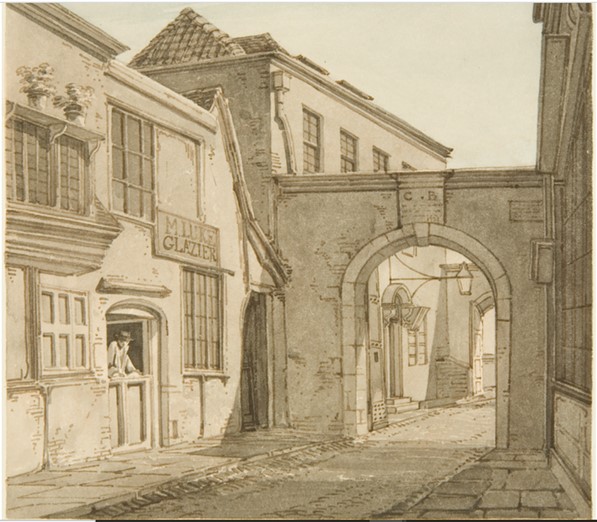
Some reports suggested that the crowd attacking the Bridewell was relatively small, but it was clearly big enough to feel boldly confident and one trial witness reckoned it almost filled the lane between the gate and Nelson Street. Several identified the Bedminster sawyer, William Clarke there, armed with either a sledgehammer or an iron bar and playing a leading role. One onlooker ‘heard Clarke and some others say they had had “some out and would have more out”’.[37]


Leaving Bridewell, the crowd marched through St Johns’ archway, up Broad Street where they liberated the Tailor’s Court sponging house, then by way of Corn Street, down Clare Street to the Quay, Princes Street and so to the New Gaol. The Unitarian minister Lant Carpenter, watched their progress, now about 4-500 strong:
I saw them, about a quarter after two, as they were coming down Clare Street on their way. They were a compact body, without stragglers or attendants. They moved with great expedition and their object was well-known; for when I first saw them, at some distance, persons near me said they were going to break open the jail. Most of them had bludgeons; some had hatchets; and others were armed with iron palisades from the front of the Mansion House.[38]
The reason for the Broad Street and Corn Street diversion is not entirely clear. It may be that Tailor’s court was a predetermined objective, in which case this was the obvious route to take, but it would also have been an opportunity to parade in triumph past first the Guildhall where the abandoned assize should have been held, and then past the Council House where hapless city magistrates were doubtless watching from the windows. By this time, one member of the crowd – very possibly Bill Clarke – had hold of the Bridewell keys, a significant and symbolic trophy for display. It would later be claimed that by evening he had seven or eight keys in his possession, from all three gaols. ‘He said he would have every gaol in England open in less than a fortnight’, recalled one witness.[39]
Reviewing the extent of the damage to Bridewell three months later, magistrates noted that although the cells had been patched up and sufficiently renovated to allow their continued use for securing suspects overnight, the governor’s house would need completely rebuilding. The best thing, they considered, would be to abandon Bridewell altogether and build a new House of Correction on a site adjoining the New Gaol.[40]
3. The great excarceration: The New Gaol
‘The extent of the riots to which a Bristol mob may go, is, I fear, not sufficiently appreciated’.[41]
Clearly, the crowd that marched on the New Gaol was considerably larger than the one that broke into Bridewell. A good deal of criticism was levelled against the city’s respectable middle class at the time for standing by in mute acquiescence instead of offering assistance to the magistrates in defending the building. Some may have felt the Gaol strong enough to look after itself. ‘At first it was supposed that the designs of the mob on the Gaol were altogether futile’, reflected William Somerton, editor of the Mercury, ‘no one imagining that so strong and, apparently, so inaccessible a place, could possibly be forced by them’.[42] Thomas Manchee, a former editor of the same paper, concurred, ‘Those best acquainted with the structure have affirmed, that twelve men might preserve it against any mob’.[43] And in his opening speech to the jury at Mayor Pinney’s subsequent trial for dereliction of duty, the Attorney General pursued a similar theme:
There never was a place which presented a more complete front to the enemy than that; the walls are very powerful, and the approach extremely difficult; the doors are strong and the entrance extremely narrow in front of the Gaol… there never was a place which admitted of more easy defence than this Gaol.[44]
Humphreys, the governor, fearing an attempt would be made on the Gaol once the Bridewell was finished with, had gone in search of advice to the Guildhall. According to the Bridewell Lane stationer, Daniel McCarthy, Humphreys ‘wished to know whether he was to defend the prison or release the prisoners. Mr Alderman Hillhouse stated he was to use his own discretion as the magistrates would give him no directions’. It is possible they went a little further than this in their advice however. Witness testimony later taken for the Enquiry commissioned by the Political Union stated that ‘although they could not recommend it, the magistrates gave him discretionary power to dismiss the prisoners if he thought it would appease the mob’[45] At any rate, Humphreys was accompanied back to the Gaol by Hillhouse and Savage with a small force of willing volunteers and ‘on condition that no arms should be used’.[46] But however solid the Gaol’s defensive wall may have looked, this was an assertive and confident crowd in no mood to be held back. According to the Bristol Gazette,
a body of gentlemen, about 30 or 40 in number, accompanied some of the magistrates to endeavour to check their proceedings but were instantly forced to retire by a tremendous volley of stones. One gentleman was knocked by a brick-bat on the side of the head and whilst down was struck with a pick-axe! He was taken home insensible.[47]
Thomas Manchee, former editor of the Mercury, was later told by Alderman Savage that this ad hoc party of gaol defenders composed some 200 men to begin with, but ‘before they had reached Princes’ Steet Bridge, their number was reduced by desertion to less than fifty’.[48]
It was now about 2.15pm.[49]Given a crowd now grown to several thousand (Eagles estimated it at 15,000, the prison taskmaster William Streaton at 12,000, although only about 1000 ‘between the gate and the river’),[50] it is hard to see what more a small and dwindling parcel of ‘gentlemen’ could have done. Humphreys, realising it would be impossible to get back into the gaol now without opening the gates to the crowd, retreated to the safety of the adjoining Bathurst Hotel and watched events unfold from there. Behind the prison walls, Streaton first knew something was wrong when he heard ’a great knocking at the gate… very loud and appeared as if made by large hammers’. He went up onto the roof of the lodge to get a better view and confirmed that they had sledgehammers but was soon forced to retreat by a volley of stones thrown up at him. ’Whilst they were beating at the gates, if a splinter was torn from them, it was thrown among the mob and there was great cheering’.[51]
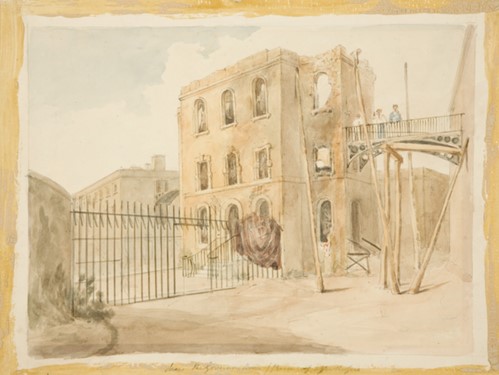
After 45 minutes labour with sledgehammers and wedges, a hole was made in the outer wooden doors of the gatehouse large enough for a man to crawl through to release the bolts on the inner iron gates. As the rest of the crowd began pushing their way in, one of the turnkeys stepped forward and released the locks, to prevent them being smashed with hammers.[52] Once in the yard, the crowd went first to William Humphrey’s (the governor’s) house, the first building they would have encountered. Quantities of his furniture and books were thrown into the Cut along with the apparatus for erecting the drop for public executions and the prison caravan, used for taking prisoners to and from the Guildhall for trial. A sack of peas was thrown in, together with a pile of prison clothing (kept on the first floor of the gatehouse), some bedding, and several paintings, including a portrait of Humphreys himself. One rioter put his foot through that before consigning it to the water. John Jeremy from Brislington was ‘very active in the mob, taking the prisoners’ gaol dresses, jackets and trousers from the people as they brought them out of the gaol and throwing them into the river’. [53]

Humphrey’s house was not just his home and office; it was the gaol’s nerve centre, a hub from which a small group of prison managers could simultaneously see into the corridors and yards of all four wings, and observe anyone coming or going through the main gate. The building’s destruction severely compromised the effectiveness of the entire radial system. While repairs to the treadmill and cells were in an advanced state by January 1832, the more extensively damaged governor’s house took much longer to rebuild. Its derelict state remained a cause of concern in the days before the opening of the Special Commission that month, because the Gaol was the only place big enough to accommodate the prisoners awaiting trial, and keeping them under close observation was deemed essential. When one prisoner managed to escape over the wall using a ladder left unattended by the repair team, an embarrassed Mayor Pinney wrote to assure the Home Secretary,
Measures are in progress for reinstating the building as early as it may be practicable, and it has been reported to me that until the house is rebuilt the Governor cannot have that entire review of the different parts of the prison which he professed previously to the destruction of the house and which is desirable for the complete superintendence and control over the prison.[54]
From the point of view of the crowd at least, burning down Humphrey’s house made perfect sense.
Next, the iron doors securing the four wings were tackled with hammers taken from the adjoining shipyards and the prisoners all released. According to James Carver, one of the debtors, the women were released first, and then ‘I was obliged by their threats to leave the gaol’.
The scenes which followed were beyond description. Many of them, both male and female, stripped off their clothes and proceeded on their way almost in a state of nudity. As they passed along, the mob cheered them and followed after them with exultations. Many of them met their friends on the outside, and it is not easy to depict the extravagant joy with which they mutually embraced each other.[55]

In Somerton’s estimation, there was joy too amongst the large crowd of spectators on both sides of the cut. ‘Up to this period, it must not be denied’, he wrote, ‘a strong prejudice was in full operation among the majority of spectators in favour of the rioters’, as evidenced by their cheering as more and more items could be seen floating away on the ebbing tide.[56]
At about 9.30pm, a detachment of about 20 men from the 3rd Dragoons arrived, under a young cornet named Kelson. As Eagles saw it, the most active rioters – about 200 people – were then inside the prison and could quite easily have been secured behind the walls if the gate was blockaded. It had not, after all, been greatly damaged. But Kelson believed himself under instructions from Colonel Brereton not to engage the crowd, but to simply see what was going on, so having done so, he ordered their withdrawal. This was not quite how Brereton himself put it in a long and rambling statement a month later in advance of his court martial. As soon as he heard of the attack on the Gaol, recounted Brereton,
I immediately ordered Cornet Kelson with a party to go there and endeavour to defend it from the fury of the mob. Some time after this the officer returned, stating that the countless thousands there assembled left it impossible for him to risk his small force, seeing no magistrate or civil authorities to support or assist him.[57]
In any case, their licence to continue unexpectedly extended by Kelson’s about-turn, there was cheering from the crowd and some were heard to shout ‘the soldiers are with us’.[58] Officers of the Political Union, having also tried and failed to persuade the crowd to disperse, now tried to persuade the magistrates to close the swing bridges connecting the Gaol to the city and by that means contain them on the prison island, but this idea was vetoed on grounds that it might provoke an attack on the adjacent shipyards. One or two aldermen, most notably Hillhouse, had extensive business interests in the shipyards.[59]

The prison flagpole was pulled down and a makeshift black flag fashioned from a handkerchief tied to the weather cock on the gatehouse roof. Next, the governor’s house, the chapel above it and the hated treadmill were set ablaze.[60] The empty prison wings were sacked but left intact, largely because they were made of iron and stone and there was little there to burn. According to Samuel Selfe, there was some plundering nevertheless, for ‘many I saw go away with beds under their arms’.[61] Not all acts of expropriation were simple thefts however. In William Clarke’s case, it was as much about trophy-taking; not only in the capture of prison keys, but in whatever he could grab from the governor’s larder. Clarke ‘had also some Bacon which he said was Mr Humphrys’,’ testified a woman who encountered him at an inn that evening, ‘He said he would give a bit of it to the by-standers as a curiosity’. A flitch of the governor’s bacon was also shown off that evening in the Jolly Sailor on the Grove, by a man named Jacob Fowler, or ‘Hell-fire Jack’. ‘They brought a quantity of gammon with them’, testified the innkeeper, George Nock. ‘They fried the gammon and had some beer and bread with it which they paid for. They all three said the gammon came from Humphries, that Mr Humphries or Billy Humphries kept damned good bacon’.[62]
The prison chapel burned fiercely, its wooden benches upended into a combustible stack in the centre of the room. Eagles, never short of a conspiracy theory, alleged the rioters brought tins of inflammable liquid with them to spread over the wooden furnishings. Some possibly did. A 10 year old boy named David Deane swore he saw a man pouring turpentine from a tin onto piles of straw. But more substantively perhaps, Eagles pursued a narrative of disinterested compliance:
If so dense a mass as that here collected were not all rioters, the shouts of encouragement were too loud to be mistaken, and indicated a citizen population willing, and rejoicing that the King’s Gaol should be burned; and “the King and Reform” were the common passwords used alike for triumph and security.[63]
A loose language of reform was certainly in the air, as several trial witnesses testified. ‘Saw Moss take up what appeared to me to be a linen sheet, and throw it into the fire and say, “Here goes! “Reform!”, recalled one, ‘Moss was running about and crying “Reform!” This was also the moment when Christopher Davis was seen with his hat atop an umbrella, shouting ‘Now damn ye, we will have reform. This is what ought to have been done years ago’.[64] Reform was clearly taken to signify rather more in these contexts than the enfranchisement of £10 male householders. When a man calling himself Henry Jones led a small party of rioters into an inn on Limekiln Lane at 2 o’clock in the morning, he told the landlady he was ‘the head or Captain of the rioters of three parishes, naming St Phillips, St Peters and St James… He said there was no longer any Corporation and they need not to be afraid even of watchmen now’.[65]
William Clarke captured the mood of the moment as he passed over Prince’s Street bridge with the crowd making for the gaol. The bridge toll collector heard him: ‘He said, as he went by, they would have liberty’. It was Clarke, it seems, who later had charge of the prison keys. He held them up that night in the Horse and Jockey on Limekiln Lane. ‘He said they were the keys to the gaol’, recalled the merchant, James Cross, ‘and one was the master key’, or ‘the daddy of them’, as another witness had it, and within a fortnight he would have all the prisons in England opened. Then in the Boars Head, according to James Rouse, Clarke claimed he had the keys to all three prisons, Bridewell, Gaol and Lawfords’ Gate. Clarke’s avowed intention to open every gaol in the country was later seized on by the prosecution at his trial as evidence of High Treason, and suggested the charges against him should be amplified but the judges advised against it.[66]
For the Gazette, the assault on the New Gaol represented a turning point in the riots; a significant escalation from attacks on meaningful targets to attacks on more generalised forms of private property.
The attack on the public prisons had an object – such as it was – Bridewell was attacked for the sake of liberating the prisoners who had been committed, and the passing from thence to the Gaol is easily accounted for, but it is not easy to divine the motives, except wantonness and uncurbed licentiousness, which induced the rioters to set fire to the toll houses and gates on Prince’s Street bridge and Cumberland Basin. This they did on their return from the Gaol.[67]
The anonymous author of A Narrative of the Dreadful Riots and Burnings took much the same view. ‘In times of popular tumult it seems natural enough that places of public confinement should become obnoxious, and especially when they have just been made the receptacle for those who had been similarly engaged’, he reasoned. Moreover, it was the pusillanimous arrival and retreat of Kelson’s party of dragoons that convinced the crowd they would be unopposed if they progressed to fresh targets with no obvious connection to the reform struggle.[68]
Manchee too was convinced that the attack on the Gaol, ‘the most extraordinary feature perhaps of the whole transaction’, was the critical turning point, and that the fault lay squarely with the magistrates for failing to act decisively to save it. ‘Imbecility at this important crisis lost the Gaol; it led the way, by the impunity it gave to violence, to all the subsequent outrages.’ Moreover, its loss could easily have been prevented:
The Sheriffs say the wall is exposed to be scaled in every direction; but they do not add that it is so lofty and even-surfaced as not to be easily scaled without ladders, with which the mob were unprovided; and that, when scaled, there were further difficulties to be encountered. A few stones or a little hot water would have afforded an effectual protection to the portal or entrance, a few yards in front of which runs a deep, rapid and unfordable river, and half a dozen muskets on the inside, by which the leaders might have been selected through the loopholes, as was done at Merthyr, would have rendered it impregnable – yet this strong place was taken by the operations of a few dozen profligate characters, some of whom were armed with crow bars and sledge hammers.[69]
But if the Bristol Political Union are to be believed, the Gazette’s reduction of the crowd’s motivation to ‘wantonness and uncurbed licentiousness’ is too blunt a term. According to the BPU’s own account, they were ‘listened to with considerable attention’ when they arrived at the burning prison on a mission to persuade the crowd to disperse. But the mission was a failure because the crowd would ‘not be diverted from their purpose, which they said was to ransack the banks and destroy the dock gates, saying that since the erection of the gates, labour had become more scarce and wages had been lowered’. Yet self-restraint and organisation were clearly present at the prison, as the PU noted:
A barrel of beer, cider or some other liquor was placed in the courtyard of the gaol with the head knocked out; over this a fellow stood sentry and permitted the rioters to drink. One of them who was very drunk, attempting to do so, he was told that he was drunk enough and would have his bloody brains knocked out if he did not go and mind his business.[70]
There was some deliberative decision making taking place. As both the Tory Job Nott and the liberal Lant Carpenter reported,
It is said that the ringleaders seated themselves in the courtyard of the prison, to deliberate as to the places to be attacked; various schemes were brought forward; at length they sallied forth in several parties, and burnt four toll houses… a ringleader directed the operations with impudent coolness.[71]
The Gloucestershire county lock-up at Lawford’s Gate was an obvious target once Bridewell and the New Gaol had been opened and liberated without opposition. The crowd that went there ‘proceeded, with sledge-hammers across their shoulders, from the New Gaol to Lawford’s Gate, with perfect self-possession’. On arrival, ‘the keys were surrendered to them, as all resistance was useless in the absence of the civil and military power’. The cells were opened, the building fired, and another twenty men and three women released into the city.[72]
By and large, whether at Bridewell, the new Gaol or Lawford’s Gate, the crowd concentrated their energies on either the destruction or the expropriation of prison property and offered little in the way of physical violence to anyone opposing them. Nevertheless, there was a certain amount of score-settling with prison guards. John Phillips was one of the turnkeys. He watched events unfold at the gaol all afternoon, then at 5pm:
I tried to pass through the crowd under the archway between the lodges, to get some of my things to save them from the fire, when I was recognised by some of the mob as the Turnkey of the Gaol, and was violently attacked and assaulted and my hat was knocked off by some person behind me… I have never seen it since.
His assailant was Robert Ponchard, one of the prisoners released from the Bridewell earlier that afternoon, and a man already well known to the authorities. Neither was it the first time Ponchard had been in Bridewell for he had been sentenced to two month’s imprisonment there the previous February for assault. Moreover, recalled Phillips, Ponchard ‘has formerly been confined in the gaol and knew me to be the Turnkey of it.’[73]
4. The Escapees
Robert Ponchard is just one of the liberated prisoners whose fortunes we can trace beyond the afternoon of 30 October. But what of the others? According to the Tory Job Nott newspaper, the purpose of emptying the gaols was to set loose the most vicious criminal desperados in the city and so ensure its destruction.
The objects of this atrocious design were to inspire terror and increase confusion; to procure, as accomplices, men hardened in crime and to go with them to any excesses and to defeat the ends of justice by liberating the prisoners that were to be tried by Sir Charles Wetherell.[74]
And again,
The alarming report had now spread that the mob had been increased by a strong band of miscreants whose trade is plunder and who are accustomed to consider property only as a thing to be stolen… the prisons and gallows were no longer objects of terror… ‘Since the rioters have broken open the gaols and added those desperados to their number, what else can resist them?’[75]
How ‘hardened in crime’ were these released ‘desperados’? The magistrates did not publish a list of all those who escaped, but we can be reasonably sure who most of them were by checking the records of the Quarter Session court over the course of the previous year. The total number thought to have escaped at the time was 176, if we include debtors, or about 100 if we count only the felons. Very few debtors are traceable because, with the exception of two who gave evidence for the Crown at the Commission, their names have not been recorded. However, we can name 100 liberated prisoners on the felons’ side, divided thus:
| Men awaiting transportation | 15 |
| Women awaiting transportation | 1 |
| Men serving gaol terms or awaiting trial | 69 |
| Women serving gaol terms or awaiting trial | 14[76] |
We know a little about some of them. William Brayley had been in the Gaol since June, serving an eighteen month sentence for pick pocketing a silk handkerchief, when the crowd set him free. Further insights are difficult to glean, beyond the simple answer he gave to the examining magistrate, shipping magnate George Hillhouse, after his arrest: ‘All I have to say is I have no friends and I have been out of the work for the last month’.[77] Sarah Clouter was a domestic servant, sentenced to three months for stealing some napkins and a handkerchief from her employer, John Bevan. Asked to account for herself, Clouter at first declared she had ‘nothing to say’, then recanted: ‘I was forgiven from stealing those things as I owned it to Mr Bevan. I do not know whether I am doing right or wrong. I am not use to it, I refuse to sign’. [78] We might conclude that men and women like these scratched a marginal existence in a makeshift economy, but they left little impression on the historical record and their lives are not easy to reconstruct.
The majority of the released prisoners were serving relatively short gaol sentences of between three and twelve months for minor acts of larceny. Regardless of the new regime of corrective punishment, longer sentences remained extremely unusual. Just six of the total number were serving longer sentences of 18 months, while one other, 27 year-old Amey Thomas, had recently been sentenced to two years for concealing the death of an illegitimate baby. Two of the men were serving short sentences for assault, two more for receiving stolen goods, one for passing counterfeit coins, and a woman, Mary Banks, had been fined and gaoled for keeping a bawdy house, but the rest were petty thieves. Generally speaking, the transportees did not owe their greater punishment to conviction for a more serious crime, but for being repeat offenders. Collectively, we might say they were opportunists, working for money when they could, pilfering when they could not, or getting by through a combination of the two. Martha O’Brien, for instance, was a poor Irish woman awaiting trial for stealing goods from Jane Chapple’s Broad Street grocery shop. O’Brien lived hand to mouth, labouring when she could as a domestic servant and char woman, and in early September 1831 found herself once again ‘out of place’. After several visits to Chapple’s house, banging on the door ‘in great distress’ and begging for work, she was engaged for a few days to ‘wash the house down and generally do the work of a charwoman’. As she did so, O’Brien ‘found’ a number of items of clothing and arranged to sell them to an old clothes dealer in Pithay, Bristol’s rag fair. But, caught in the act one evening, her only defence when examined was to lay the blame squarely on the Pithay dealer. She was committed to the Gaol for the coming October assize, but released back into the city by the crowd on the night of the riots, ‘as she herself stated, entirely against her own will’. She was not heard of again until May 1832, when, according to the Bristol Mirror,
Not knowing what to do, she came to London and, resuming an acquaintance with a young man whom she had formerly known, they were married. On Friday afternoon she was met in the street by a person who had known her at Bristol… and she was apprehended. The poor creature seemed greatly distressed.
O’Brien was taken back to Bristol, finally put before the Quarter Session in October, convicted, and transported for life.[79]
James Green and John Smith were serving sentences of twelve months a piece for picking pockets amongst the crowd gathered to watch Recorder Wetherell’s arrival to open the Spring assize.[80] Ann Cale and Jane Manley were two young girls serving twelve months each for stealing shoes from a shop in Baldwin Street, and James Cane was serving 4 months for pilfering five bottles of porter from a wagon in Prince Street. Cane was just ‘a boy’, seen running away with the beer in the company of several other youths and traced to Queen Square where they sat down to drink and ‘throw about a bottle’.[81] Plenty of the prisoners were young. Of the 56 escapees whose ages are recorded, 42 were aged between 12 and 22, with the largest cluster (26 prisoners) aged between 15 and 18. Edward Taylor was 14, gaoled for helping two older boys steal a writing desk from a shop when the owner wasn’t looking, and John Chard was 16, gaoled for breaking into a shop and stealing a coat and trousers. Seventeen year old Charles Walker was awaiting transportation after being caught by a Watchman raiding a gentleman’s larder for meat in Portland Square.[82] The two youngest escapees were just 12 years old: John Facey had been sentenced to seven years transportation at the October sessions for grabbing a purse in Redcliff Street, while Henry Hicks had been gaoled for six months for stealing a cheese.[83]
Few of the escapees enjoyed their freedom for long. Within a week of the attack on the Gaol, the Bristol Mercury confidently claimed ‘nearly two thirds of them have either been recaptured or have surrendered’. Nevertheless, by the end of the year it was reported that eight transportees and 22 convicts serving prison terms were still at large.[84] Some were definitely recaptured. James Cobley, who had already endured seven years as a transportee between 1823 and 1830, had been reconvicted at the October Quarter Sessions for stealing seven ducks and was awaiting transportation for a further fourteen years when he was unexpectedly liberated that Sunday night. His liberation was brief however for he is recorded as entering the hulks in January 1832.[85] Sixteen year old Thomas Peters (or Pester) made it to London and remained at liberty until December when, on applying for relief from the Mendicity Society, his identity was discovered. He was sent briefly back to Bristol, then entered onto the hulks.[86]
Unsurprisingly, some prisoners were believed to have joined the rioters. One of these, James Colman, allegedly led a crowd to the house of Thomas Blethyn, his former employer, in an attempt to extort money from him, then fled the city when the riots were over. Colman was retaken in Ireland in January and brought back to Bristol to be questioned about the incident with Blethyn. As he explained it to examining magistrates, ‘As I got out of the prison the Sunday evening, I got the key and my box from Mr Stratton the Turnkey but as I went up into the street, I saw that I had not a halfpenny in the world to buy me a bit of bread’. The money he demanded was owed to him, he maintained, unpaid by Blethyn because he had been in prison. He was not tried a second time.[87] George Richards, 18 years old and a better organised thief than many of his fellow convicts, had been sentenced to transportation for 14 years for stealing 90 pairs of shoes from the warehouse he worked in. Richards made his way to Wales and hid himself for some months in the close mining community of Abersychan but was eventually recaptured in February 1832.[88] George Fisher wasn’t caught until April.[89]. But perhaps the most tenacious was 14 year old George Edwards, rearrested at Birmingham in August 1832 after getting caught picking pockets. Previously convicted for petty thefts not only in Bristol but at Worcester and Coventry as well, Edwards cut an unsympathetic figure in the dock and was transported for 14 years. ‘Thankyou my Lord, and long live the King’, he is alleged to have declared in a parting shot.[90]
But others, like John Ford awaiting trial for manslaughter, simply gave themselves up.[91] William England had been sentenced to transportation for seven years for stealing felt and glue from his master’s hat manufactory, but presumably hoping his previous good conduct would earn him a reprieve, his wife petitioned for clemency. The petition is annotated, ‘liberated from gaol by the mob but afterwards surrendered himself’.[92] The shoplifter Jane Manley, on the other hand, may or may not have surrendered herself, but she was back in the Gaol by the end of 1832 anyway after being convicted a second time (for stealing bacon) and sentenced to seven years transportation to New South Wales in 1833.[93]
The fate of the released transportees is easiest to trace because those that were recaptured and transferred to the hulks were recorded as such in the penal bureaucracy of the period. On 21 February 1832, five of them were awarded places alongside nineteen of the rioters convicted at the January Special Commission, on the Katherine Stewart Forbes, bound for Van Dieman’s Land: Henry Fewens, Thomas Pester (or Peters), James Cobley, Thomas Stratton, and George Thorne. Four others were transported somewhat later:
| Charles Walker | The England | 31 March 1832 |
| George Richards | The Circassian | 4 November 1832 |
| Thomas Roberts | The Circassian | 4 November 1832 |
| John Facey | Lord Lynedoch | 30 May 1833 |
Whether these four sailed later because they evaded capture for longer, or just because they spent more time on the hulks than the first five, remains a matter of speculation. If newspaper reports were correct in claiming that eight transportees were still at large at the beginning of 1832, the former is perfectly possible. Five remained indefinitely unaccounted for: Daniel Keefe, James Shelrock, Jacob Hopkins, Thomas Tucker and Henry Frend. These men make no appearance in the legal record as transportees, either to Van Dieman’s Land or New South Wales, and it wasn’t because they were pardoned because they did not petition for clemency either. Just one of the New Gaol escapees received an official respite from transportation: William England, the man whose petition recording his immediate surrender to the authorities after his release by the crowd has already been noted. The single female transportee to be released, 22 year old Jane Shannon, a young prostitute convicted of robbing a client in Deep Street, also evaded a voyage to the colonies, but only because she died in prison before she could be sent on board. Shannon was due to sail on the Fanny with a ship load of female convicts on 14 July, but she died on 6 July, quite possibly from cholera, a disease that had already ripped through the convicts on the Katherine Stewart Forbes. Twelve year-old Henry Hicks wasn’t a transportee at the time of the riots; he’d been sentenced at the Michaelmas sessions a few days earlier to six months in the New Gaol for stealing a cheese. Whether or not he was recaptured that autumn, Hicks was back in court by the close of 1832, convicted this time for stealing two casks of butter, and as it was his second offence, sent to Van Dieman’s Land for seven years in 1833. His was a salutary tale. First put to work breaking rocks and building the Grass Tree Hill road, he frequently found himself in trouble for drunkenness, insolence, and violent conduct, earning at least two whippings and several periods of solitary confinement before regaining his freedom in 1840. Hicks remained in Tasmania, got married and had three children, but in 1846 he was arrested again in Hobart, this time for stealing a cask of oil, and sent
back to hard labour for the next 30 months. Between 1851 and 1859 when he finally disappears from the record, Henry Hicks’ life was structured around a revolving cycle; from conditional pardons and tickets of leave, to arrest for absconding and his tickets revoked. His entire life experience, from childhood in Bristol to the rough justice of the Tasmanian penal settlement had been framed by violent conflict with the institutions of Law.[94]
5. Conclusion
As we know from the fate of London’s various gaols and lock-ups during the Gordon Riots, crowd attacks on prisons were not an unknown phenomenon in Georgian England. In most cases, the objective was limited: to liberate crowd members captured and secured by the authorities; indeed this is how things began in London in 1780, and in Bristol in 1831. Like the delivery of the Paris Bastille in 1789, both of these events can be seen as turning points in larger, more prolonged crowd actions, albeit, in the British examples, actions that did not result in revolution. They were, nevertheless, a direct and very serious challenge to the apparatus of law enforcement, and an understandable cause of consternation to the contemporary press. Commentary often adopted an alarming tone and was prone to exaggeration. On the second day of the Birmingham Priestley (or ‘Church and King’) riots in 1791, reports quickly circulated that all the prisoners in at least two gaols had been forcibly released. ‘The gaols have been broke open and all the prisoners liberated’, declared a horrified General Evening Post, and a pamphlet account concurred: ‘the doors of every place of confinement were thrown open’. If these reports were true, it can certainly not have been instigated as a rescue mission, for no arrests had yet been made. Indeed, according to one report, when a member of Priestley’s congregation tried to take up one rioter and deliver him to the town lock-up, the turnkey refused to take him in. In calmer tones, the Post clarified its first report a few days later:
There is no prison at Birmingham except a dungeon; a kind of temporary Watch-house that had been forced open by the rioters, as also the House of Safety for Debtors there; but no prisoners were in either, and therefore nor any have been released, as former reports have stated.[95]
We have more recent precedents to draw on than these, but none in which a state of the art and eminently defendable modern prison of the New Gaol’s stature were overcome with such bold determination, and none in which sacking and destruction by fire was also attempted. Greenock Gaol was attacked during the Scottish insurrection of 1820, and five political radicals released, but all non-political felons were left locked up in their cells. In the same year, eleven smugglers, and several other prisoners too, were released from Dover gaol by a crowd shouting ‘Liberty Forever!’, an attack was made on Peel gaol on the Isle of Man to free a food rioter in 1821, and there were attacks on the Rope Street lock-up at Rochdale during the weaving disputes in 1808 and 1829. On the first occasion, the building, ‘which was supposed to be impregnable’ was not only liberated but set on fire, ‘which was supposed to be impossible, so much of it made of stone’, and the building reduced to ‘ruinous walls’, but this was by no means a prison of comparable size or defensive design to Bristol’s. The second attempt was unsuccessful.[96]
More recently still, and perhaps more significantly however, on the first night of English Reform Bill rioting just three weeks before rioting broke out in Bristol, two gaols had been attacked at Derby. There, as at Bristol’s Bridewell, the initial objective was the release of a handful of prisoners taken up for rioting and confined overnight in lock-ups. In both Derby and Bristol, crowds released non-political felons and debtors as well as reform rioters from old fashioned holding cells, and then turned on larger, better defended local prisons (in Derby’s case, the County Gaol) in a bid to liberate all prisoners, regardless of their offence. Neither the County Gaol at Derby nor the New Gaol at Bristol held any prisoners taken up for rioting at the time they were attacked. At Derby, crowds were repulsed at the County Gaol by gunfire and a well-organised defensive force, while at Bristol, as we have seen, it was a somewhat different story. We might also consider events in Worcester on 5 November. Rioting at Worcester was on a smaller scale than the outbreaks at either Bristol or Derby, but given that it was the only serious disturbance to take place in the immediate aftermath of the attack on Bristol’s New Gaol, the local authorities half expected a repetition. Fifty-strong groups of special constables were despatched to guard both the City and the County gaols, and a party of militia added at the County gaol for good measure. That evening, after successfully negotiating with the mayor for the release of two rioters from the city gaol, the crowd remained outside the building and demanded a general release of all riot prisoners, but this was refused and they did not press their numerical advantage by launching an attack. Newspapers expressed little doubt of their general intention, however, for the County gaol contained a large number of colliers and nailers, convicted for riot during an industrial dispute at Kidderminster a year earlier. The Globe for one believed it made the County gaol a target and that it would have been attacked were it not for the constables and soldiers sent by the mayor to protect it. We can safely state then, that the attack on Bristol New Gaol was by far the most serious assault on any British prison since the Gordon Riots fifty years earlier.[97]
Over the previous ten years, Bristolians will have been aware not only of the New Gaol’s bulky intrusion into the spatial topography of the city, but of the popularity of its corrective regime amongst the city magistrates. Whereas in the years before its construction, transportation had accounted for a greater number of sentences than imprisonment, the opposite was true after 1820. While transportation physically removed convicts far from the influence of friends and families, the Gaol kept them close at hand but screened by a seemingly impregnable 20 foot wall. Escape wasn’t unthinkable, but neither was it easy. Four prisoners did manage to break out soon after the Gaol opened by absconding from the infirmary and scaling the wall with the aid of some tied sheets, but escapes were few and far between after that.[98] Tim Hitchcock and Bob Shoemaker have argued that the crowd targets selected during the Gordon Riots become more comprehensible once we stop trying to read them too literally as expressions of anti-Catholicism. Londoners in 1780 had more on their minds than the Catholic Relief Act when they stormed the capital’s gaols and released up to 1,600 prisoners in the name of ‘Liberty’. The assaults on London’s prisons, the argue, represented ‘a powerful hostility towards criminal justice and its institutions and not simply those which contained prisoners arrested in the riots’. Indeed, only three captured rioters were being held at Newgate when it was attacked and delivered. Hitchcock and Shoemaker conclude, ‘We should, not underestimate the profound significance of these assaults on the prisons, or the extent to which they heralded a desperate, if inchoate, revolutionary moment’.[99]
Bristol in 1831 was not London in 1780. London’s prisons were filthy and overcrowded, a situation exacerbated by the forced curtailment of transportation to America during the war of independence. Bristol’s courts could choose either imprisonment or transportation as punishments for felony, but usually opted for the latter only where magistrates felt an example needed to be made, or because the prisoner had been convicted for a second offence. The Gaol was full in 1831 but not overcrowded, the diet, while not particularly nutritious, was better than it had been at the old gaol, and the building was both airy and clean. However, the physical and mental strain imposed on prisoners by the treadmill on the one hand and new regimes of constant surveillance and non-associative discipline on the other, will surely have left its mark on attitudes to the criminal justice system amongst the city’s labouring poor. It is worth remembering, moreover, that the riots began as an escalation of protest not just against an anti-reformer, but against an anti-reformer who also happened to be the Recorder, the most important and powerful representative of the city’s judicial framework. The crowd’s first action was, perhaps inadvertently, to cause the cancelation of the official gaol delivery – a court with capital jurisdiction, presided over by the Recorder and which twice yearly sent convicts to the New Gaol.
In Bristol’s case, hostility to anti-Reformers in Parliament had become inextricably entangled with ‘hostility towards criminal justice and its institutions’, through objection to the central figure of Sir Charles Wetherell. The Job Nott put it this way,
Of all the outrages, that in which the rioters seemed to glory most was the liberation of the prisoners. ‘Sir Charles Wetherell has come to try the prisoners. Well, we shall save him the trouble and make the gaol delivery ourselves!’ This was their villainous boast and it was quite according to their wild notions of liberty’.[100]
While it would be stretching the evidence to call the Bristol riots an inchoate, revolutionary moment, the excarceration of the Gaol makes little sense in the context either of a literally understood ‘reform riot’, or as a meaningless outburst. What we can say however is that the delivery of the Gaol was an extraordinary and transformative moment; the central act in three days of destructive activity that began as a window-breaking protest against the Recorder and finished with the firing of private housing and a massacre at the hands of the military.
Author: Professor Steve Poole, UWE
This is a working paper which may be updated before the project ends (29/02/2024). As it is subject to change, it is currently under © University of the West of England and all rights are reserved. Please contact the authors for any copyright permissions. Please note that upon completion of the project, all papers will be released under a CC-BY licence.
This work was supported by the ESRC [grant number ES/T00293X/1].
Footnotes
| ⇧1 | Rev George Crabbe, June 1780, quoted in Peter Linebaugh, The London Hanged: Crime and Civil Society in the Eighteenth Century (Penguin, 1991), p.334. |
|---|---|
| ⇧2 |
A conversation allegedly overheard between Bristol rioters in Queen Square on the night of 30 October 1831, and reproduced in W. H. Somerton, A Narrative of the Bristol Riots on the 29th, 30th and 31st of October, 1831 (Bristol, 1832), p.31. |
| ⇧3 | Ian Haywood, ‘A Metropolis in Flames and a Nation in Ruins: The Gordon Riots as Sublime Spectacle’, in I. Haywood and J. Seed, The Gordon Riots: Politics, Culture and Insurrectionary Politics in Late Eighteenth Century Britain (Cambridge: Cambridge University Press, 2012), p.119. |
| ⇧4 | Nicholas Rogers, ‘Nights of Fire: the Gordon Riots of 1780 and the Politics of War’, in Michael T. Davis, (ed.), Crowd Actions in Britain and France from the Middle Ages to the Modern World (Palgrave, 2015), p.131. |
| ⇧5 | Linebaugh, London Hanged, pp.341-2. |
| ⇧6 | Crimping houses were buildings, usually taverns, in which men were plied with alcohol and duped into enlistment into the army. A sponging house was a small debtor’s prison. |
| ⇧7 | The Trial of Charles Pinney, Esq., (Late Mayor of Bristol,) in the Court of King’s Bench, for Imputed Neglect of Duty During the Riots of 1 831 (Bristol, 1832), p.6. |
| ⇧8 | A Plain Account of the Riots at Bristol on the Last Three Days of October, 1831, by Nehemia, a Friend of the Labouring Classes, p.22. |
| ⇧9 | Thoughts on Education, Union of Classes and Co-operation, Suggested by the Late Riots at Bristol (London 1831), p.6. |
| ⇧10 | John Stevenson, Popular Disturbances in England, 1700-1870 (London, 1979), p.222. |
| ⇧11 |
Mark Harrison, Crowds and History: Mass Phenomena in English Towns, 1790-1835 (Cambridge, 1988), pp.297-8 & 305-9; Jeremy Caple, The Bristol Riots of 1831 and Social Reform in Britain (Edward Mellon press, 1990), pp.142-3. Harrison was partly swayed by the testimony given a year later at the trial of the mayor and magistrates by ironmonger and Quaker, Samuel Self: ‘After the private property in Queen Square was attacked, there was a manifest disposition to assist the magistrates… he is aware that there is a very strong dislike against the Corporation’. Questioned by the Attorney General, Self conceded, ‘There is a party also in favour of the Corporation. It consists of the respectable tradesmen’, although Harrison passed this part of his testimony over. Self’s testimony was also picked up and made something of by Pinney’s defence barristers to demonstrate that public hostility to the Corporation was what made it impossible for the mayor to enrol an effective force of constables to disperse the crowds: ‘The fact was that it was not until the inhabitants found that other property besides the Corporation’s property was endangered by their apathy that they showed any readiness to come forward to give necessary aid’. And when the Mansion House fell, ‘the cry was “Oh! ‘tis only Corporation property”’. Thus, it was argued in Pinney’s defence, it was immaterial if there had only been 100 or so active rioters, for ‘if a thousand persons were looking on, a sufficient force would be necessary to remove the whole thousand’. Trial of Charles Pinney Esq., pp.31 & 77. |
| ⇧12 | Report of the Committee of the Society for the Improvement of Prison Discipline and the Reformation of Juvenile Offenders (London, 1820), p.42. |
| ⇧13 | Committee of the Society for the Improvement of Prison Discipline, Remarks on the Form and Construction of Prisons with Appropriate Designs (London, 1826), pp.35 & 40. |
| ⇧14 | Examiner, 11 July 1819. |
| ⇧15 | Pierce Egan, Walks Through Bath (Bath, 1819), p.242. |
| ⇧16 | Joseph Matthews, The Bristol Guide, Being a Complete Ancient and Modern History of the City of Bristol, the Hotwells and Clifton (Bristol, 1825), p.85. |
| ⇧17 | John Chilcott, Chilcott’s New Guide to Bristol, Clifton and the Hotwells (Bristol, 1826), p.134. |
| ⇧18 | Matthews Complete Bristol Guide; Forming an Ancient as wellas a Modern History of that Opulent Provincial Metropolis (seventh edition, Bristol 1828), p.84. |
| ⇧19 | John Chilcott, Chilcott’s New Guide to Bristol, Clifton and the Hotwells (Bristol, 1826), p.134. |
| ⇧20 | Gaols: Copies of All reports and of the Schedules |
| ⇧21 | Gaols: Copies of All reports and of the Schedules… for Consolidating and Amending the Laws Relating to the Building and repairing and Regulating Certain Gaols and Houses of Correction in England and Wales (House of Commons, February 1825), pp.317-321. |
| ⇧22 | Report from the Select Committee on Secondary Punishments Together with the Minutes of Evidence (House of Commons, June 1832), p.138. |
| ⇧23 | First Report of the Select Committee of the House of Lords Appointed to Inquire into the Present State of the Several Gaols and Houses of Correction in England and Wales with Minutes of Evidence (House of Commons, May 1835), p.155. |
| ⇧24 | Gaols: Copies of All reports and of the Schedules, pp.317-321. |
| ⇧25 | Present State of the Several Gaols and Houses of Correction, p134. For the silent system’s introduction see Rules and regulations for the Management of the Gaol and House of Correction in the City and County of Bristol (Bristol, 1840). |
| ⇧26 | Gaols: Copies of All reports and of the Schedules, pp.317-321. |
| ⇧27 | Present State of the Several Gaols and Houses of Correction, p.155. |
| ⇧28 | Joseph Matthews, The Bristol Guide, Being a Complete Ancient and Modern History of the City of Bristol, the Hotwells and Clifton (Bristol, 1825), p.85. For the chevaux de fries see HO 40/28, Charles Pinney to Lord Melbourne, 13 January 1832, f.187. |
| ⇧29 | Third Report of the Committee of the Society for the Improvement of Prison Discipline and for the Reformation of Juvenile Offenders (London, 1821), pp.56-7; Bristol Mirror, 6 October 1827. |
| ⇧30 | For a positive contemporary eulogy to the treadmill see Third Report of the Committee of the Society for the Improvement of Prison Discipline and for the Reformation of Juvenile Offenders (London, 1821), pp.129-171, and Description of the Treadmill Invented by Mr William Cubitt of Ipswich for the Employment of Prisoners, as Recommended by the Society for the Improvement of Prison Discipline (London, 1822). |
| ⇧31 | A student of the Inner Temple, Thoughts on Prison Labour (London, 1824), pp.5-7. For treadmill advocacy from the Society for the Improvement of Prison Discipline, see for example Bristol Mercury, 9 June 1823. |
| ⇧32 | Gaols: Copies of All reports and of the Schedules pp.317-321. |
| ⇧33 | TNA HO 52/12, Report of the Solicitors to the Committee of Enquiry, December 1831, p.11, f.147. |
| ⇧34 | Keynsham was where they finally found billets. The Courts Martial Upon Lieut, Col. Brereton and Captain Warrington for Imputed Neglect of Duty During the Bristol Riots (Bristol 1832), pp.7-8; Nehemiah, a Friend of the Labouring Classes, A Plain Account of the Riots at Bristol on the Three Last Days of October 1831 (Bristol, 1832), pp.14 & 17. |
| ⇧35 | According to the Unitarian minister Lant Carpenter who witnessed the march from Bridewell to the Gaol, these sledge hammers were ‘borrowed’ rather than simply taken, for ‘the proprietor told me that they brought all back but two’. Rev. L. Carpenter, ‘On the Bristol Riots’, Monthly Repository and Review of Theology and General Literature, 5, 60 (December 1831), p.848. |
| ⇧36 | Trials of the Persons Concerned in the Late Riots Before Chief Justice Tindal and Justices Bosanquet and Taunton (Bristol 1832), charge of the Attorney General, p.27; evidence of Thomas Evans, pp.28-9; evidence of Edward Percival, p.32; A Citizen (John Eagles), The Bristol Riots: Their Causes, Progress and Consequences (Bristol, 1832), pp.100-101. |
| ⇧37 | Trials of the Persons Concerned in the Late Riots, evidence of William Selwyn, p.5; evidence of Harriet Vowles, p.9; |
| ⇧38 | Rev. L. Carpenter, ‘On the Bristol Riots’, p.847. |
| ⇧39 | Trials of the Persons Concerned in the Late Riots, evidence of John King Jnr., p.14; evidence of James Rous, p.34; evidence of James Cross, p.34. |
| ⇧40 | Bristol Archives, JQS/D/20, Quarter Session Docket Book 1830-1835, entry dated 23 February 1832. |
| ⇧41 | William Ody Hare, Under Sheriff of Bristol, giving evidence in Trial of Charles Pinney Esq., in the Court of King’s Bench on an Information Filed by His Majesty’s Attorney General, Charging him with Neglect of Duty in his Office as Mayor of Bristol During the Riots (Bristol, 1832), p.253. |
| ⇧42 | W. H. Somerton, A Narrative of the Bristol Riots on the 29th, 30th and 31st of October, 1831 (Bristol, 1832), p.21. |
| ⇧43 | Thomas John Manchee, The Origin of the Riots of Bristol and the Causes of the Subsequent Outrages, with a Letter Dedicatory to the Lord Viscount Melbourne (Bristol, second edition, 1832), p.29. |
| ⇧44 | Trial of Charles Pinney Esq., in the Court of King’s Bench on an Information Filed by His Majesty’s Attorney General, Charging him with Neglect of Duty in his Office as Mayor of Bristol During the Riots (Bristol, 1832), p.13. |
| ⇧45 | HO 52/12, Report of the Solicitors to the Committee of Inquiry, 31 December 1831, f.150 |
| ⇧46 | Trial of Charles Pinney, p.40. According to some newspapers, Humphreys was ‘politely sent away in a “fly” which the mob ordered from the stand’, but there is no evidence to support the story. See Wolverhampton Chronicle 9 November 1831. |
| ⇧47 | Bristol Gazette, 3 November 1831. |
| ⇧48 | Manchee, The Origin of the Riots of Bristol, p.32 |
| ⇧49 | According to the prison task master, William Streaton, who told the Commission this was when he heard the first hammering on the gates. Trials of the Persons Concerned in the Late Riots, evidence of William Streaton, p.2. |
| ⇧50 | Eagles, Bristol Riots, p.102; Trials of the Persons Concerned in the Late Riots, evidence of William Streaton, p.2. Much contemporary commentary drew a meaningful distinction between the crowd actively engaged in forcing an entry to the prison and sacking it (perhaps 200 people), the supporting crowd of rioters who went with them (perhaps 1000), and the much larger crowd of onlookers on the southern side of the Cut (several thousand). The issue at stake here was the size and strength of the actively rioting crowd, and the size and strength of the force, civil or military, required for its effective dispersal. See for example, A Plain Account of the Riots at Bristol on the Last Three Days of October, 1831, by Nehemia, a Friend of the Labouring Classes, p.20. |
| ⇧51 | Trials of the Persons Concerned in the Late Riots, pp.2, 11. |
| ⇧52 | Trials of the Persons Concerned in the Late Riots, evidence of John Phillips, p.6. |
| ⇧53 | HO 40/28, Information of William Humphreys, 9 November 1831, f.287; information of William Bishop, constable of Brislington, 9 November 1831, f.288. |
| ⇧54 | HO 40/28, Charles Pinney to Lord Melbourne, 19 January 1832, f.205 |
| ⇧55 | Trials of the Persons Concerned in the Late Riots, evidence of James Carver, p.6 and John Williams, p.15; HO 40/28, information of James Carver, 11 November 1831, f.300; Bristol Gazette, 3 November 1831. |
| ⇧56 | W. H. Somerton, A Narrative of the Bristol Riots, p.21. |
| ⇧57 | For Brereton’s version, see his submission to the Court of Enquiry in HO 52/12, 24 November 1831, f.331. At Brereton’s later Court Martial, Kelson, the captain of the detachment, deposed, ‘I asked him [Brereton] what I was to do when I got there. He replied that he could give me no orders to act, for he could find no magistrate to give him any orders. I was on no account to use any violence but to go there and return’. This was the last piece of evidence given against Brereton, on the fourth day of the trial, before he shot himself. Kelson, incidentally, may have been young but he was not inexperienced in handling protest crowds, having served in the Forest of Dean under Mackworth earlier that year. The Courts Martial Upon Lieut.-Col. Brereton and Capt. Warrington for Imputed Neglect of Duty During the Bristol Riots (Bristol, 1832), p.35. For Kelson’s military experience see p.87. |
| ⇧58 | Eagles, Bristol Riots, p.104. |
| ⇧59 | W. H. Somerton, A Narrative of the Bristol Riots, pp.22-3. |
| ⇧60 | Repairs to the treadmill were ongoing by January. See HO 40/28, Charles Pinney to Lord Melbourne, 13 January 1832, f.187. |
| ⇧61 | Trial of Charles Pinney Esq., in the Court of King’s Bench, evidence of Samuel Selfe, p.70. |
| ⇧62 | HO 40/28, information of Mary Ann Schubert, 12 November 1831, f.305; BA JQS/P/700, information of George Nock, 14 November 1831. |
| ⇧63 | Eagles, Bristol Riots, p.105 Trials of the Persons Concerned in the Late Riots, evidence of David Deane, p.12 . |
| ⇧64 | Trials of the Persons Concerned in the Late Riots, evidence of William White, p.35. |
| ⇧65 | BA JQS/P/700, information of Ann Taylor, 8 November 1831. |
| ⇧66 | Trials of the Persons Concerned in the Late Riots, evidence of James Wyatt, Robert Trickey, James Rouse and James Cross, pp.8-10. |
| ⇧67 | Bristol Gazette, 2 November 1831. |
| ⇧68 | A Narrative of the Dreadful Riots and Burnings which Occurred in Bristol… and the Destruction of Property and Lives Consequent Upon Them, p.15 |
| ⇧69 | Manchee, The Origin of the Riots of Bristol, p.30. |
| ⇧70 | B(ritish) M(useum) Add Ms 27790, Francis Place Collection, ‘Narrative account of the Bristol Political Union’ (1831), p.187. |
| ⇧71 | Nehemiah, Plain Account, p.21. This story was confirmed by Lant Carpenter: ‘persons who seemed to be leaders had held a council at the entrance to the Jail at which the course of their proceedings was settled’. Lant believed they intended to complete the destruction of the Mansion House, then burn the Bishop’s Palace before climbing the hill to Sheriff Lax’s house on Park Street, and the houses of the Tory Aldermen, Fripp and Daniel in Berkely Square. Rev. L. Carpenter, ‘On the Bristol Riots’, p.847 |
| ⇧72 | Trials of the Persons Concerned, 15. |
| ⇧73 | HO 40/28, information of John Phillips, 16 November 1831, f.319; information of Thomas Evans, 14 November 1831, f.320. For Ponchard’s earlier assault conviction see Bristol Times and Mirror, 12 February 1831. |
| ⇧74 | Nehemiah, Plain Account, p.20. |
| ⇧75 | Nehemiah, Plain Account, p.25. |
| ⇧76 | There were undoubtedly more people still awaiting trial amongst those released that night than we have accounted for here. Depositions for some of them have survived: Benjamin Shorland (20 October) and William Andrews (22 October – both for thefts) and Sarah Parker (26 October, keeping a disorderly house) BA JQS/P/691. |
| ⇧77 | BA JQS/P/694, examination of William Brayley, 13 April 1831. |
| ⇧78 | BA JQS/P/694, information of John Bevan; examination of Sarah Clouter, 21 April 1831. |
| ⇧79 | BA, JQS/P/700, Information of George Parsons and Jane Chapple; examination of Martha O’Brien, 5 September 1831; Bristol Times and Mirror, 10 September 1831; 19, 26 May, 20 October 1832. |
| ⇧80 | BA JQS/P/694, examination of John Smith, information of Thomas Watkins, 13 April 1831. |
| ⇧81 | BA JQS/P/684, information of John Eames, 18 April 1831; Information of Joseph Sergeant, 14 April 1831; JQS/P/694, information of William Gibbons Medicott, 18 April 1831. |
| ⇧82 | BA JQS/P/700, information of Edward Goss esq., 19 September 1831; Bristol Mercury, 4 January 1831. |
| ⇧83 | Bristol Mercury, 18 October 1831. |
| ⇧84 | Bristol Mercury, 5 November 1831; Mayo Constitution, 29 December 1831. |
| ⇧85 | Bristol Times and Mirror, 22 October 1831. |
| ⇧86 | Public Ledger and Daily Advertiser, 13 December 1831. |
| ⇧87 | TNA, ASSI 6/3 examination of James Coleman, 2 January 1832; Bristol Mercury, 3 January 1832. |
| ⇧88 | Bristol Mirror, 25 February 1832 |
| ⇧89 | Cheltenham Journal, 9 April 1832 |
| ⇧90 | Warwick and Warwickshire Advertiser, 18 August 1832. |
| ⇧91 | Bristol Mercury 7 January 1832. |
| ⇧92 | BA JQS/P/691, information of John Dowell, 24 September 1831; Bristol Mercury 25 October 1831; TNA, HO17/51/96 |
| ⇧93 | Bristol Mercury, 5 January 1833. |
| ⇧94 | The fate of the transportees can be traced easily enough in a number of ways. Tasmania’s Founders and Survivors database (foundersandsurvivors.com) is one very user-friendly digital portal to the sources, and the Digital Panopticon (digitalpanopticon.org) is another. Shannon’s death is recorded in the British Transportation registers btr113733 (entry for 14 July). For the later criminal career of Henry Hicks, see Libraries Tasmania, CON31-1-20 (image 220), CON37-1-3, p.712 (Image 111), and Bristol Mirror, 8 December 1832. For cholera on the Katherine Stewart Forbes, see ‘Appendix: The Transported Convicts’, in Geoffrey Amey, City Under Fire: The Bristol Riots and Aftermath (London, 1979), pp.186-7. |
| ⇧95 | An Authentic Account of the Riots in Birmingham on the 14th, 15th, 16th, and 17th days of July 1791 (London, 1791), p.7; General Evening Post, 19, 21 July 1791; R. B. Rose, ‘The Priestley Riots of 1791’, Past & Present, 18 (1960), p.81. |
| ⇧96 | Peter Berresford Ellis and Seumas Mac a’Ghobhainn, The Scottish Insurrection of 1820 (London, 1970), pp.196-7; Cumberland Pacquet, 15 October 1821; Bell’s Weekly Messenger, 29 May 1820; Chester Chronicle, 15 May 1829; St James’s Chronicle, 10 September 1808. |
| ⇧97 | The Trial of the Eleven Persons Charged with Breaking Open the Gaol of the Borough of Derby and Liberating the Felons and Other Prisoners on Sunday 9th of October 1831, and their Acquittal (Derby, 1832); The Globe, 8 November 1831; Worcester Journal, 10 November 1831; Worcester Herald, 12 November 1831. |
| ⇧98 | Bristol Mirror 24 March 1821. All four were recaptured in Montgomery a month later: Bristol Mirror, 28 April 1821. |
| ⇧99 | Tim Hitchcock and Robert Shoemaker, London Lives: Poverty, Crime and the Making of a Modern City, 1690-1800 (Cambridge, 2015), pp.340-352. |
| ⇧100 | Nehemiah, Plain Account, p.24 |